Introduction
Goods and Services Tax compliance in India has evolved into a continuous digital reporting framework driven by data analytics, invoice level validation and automated reconciliation. Every sales invoice, purchase invoice, credit note and tax adjustment directly impacts GSTR 1, GSTR 3B, GSTR 2B, input tax credit eligibility and working capital efficiency.
For growing businesses, GST compliance is no longer limited to return filing. It is a financial control and risk management function that requires an integrated GST compliant ERP system.
The Business Problem
Many Indian companies manage GST compliance using standalone accounting systems, spreadsheets and manual reconciliations. This fragmented architecture creates structural risks and compliance exposure.
- Incorrect GST rate application due to wrong HSN or SAC mapping
- Place of supply errors leading to incorrect CGST, SGST or IGST classification
- Mismatch between books of accounts and GSTR 3B liability
- Input tax credit claimed but not reflected in GSTR 2B
- Delayed detection of vendor non compliance affecting ITC eligibility
- Weak audit trail during GST scrutiny or departmental notice
Why GST Compliance is Complex in India
GST compliance operates across multiple technical layers:
- Transaction level tax accuracy and GSTIN validation
- Multi return reporting including GSTR 1 and GSTR 3B
- Monthly ITC reconciliation with GSTR 2B
- Reverse Charge Mechanism compliance
- E Invoicing and E Way Bill integration
- Multi state GST registration management
How ERPNext 16 Enables GST Compliance Automation
Automated GST Rate Determination
ERPNext 16 uses tax templates mapped to HSN and SAC codes to automatically determine intra state or inter state tax based on place of supply logic.
GSTR 1 and GSTR 3B Reporting
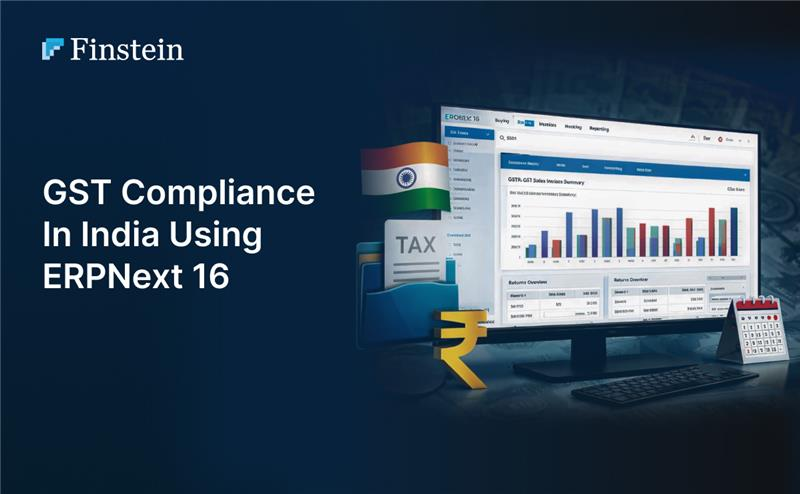
ERPNext generates statutory GST reports aligned with return formats. Outward supply registers and tax liability summaries can be exported for GST portal filing.
Input Tax Credit Reconciliation
Purchase registers can be reconciled with GSTR 2A and GSTR 2B data to identify missing invoices and protect eligible ITC.
Reverse Charge Automation
ERPNext automates reverse charge mechanism entries by posting GST liability and corresponding input credit in compliance with GST law.
E Invoicing Integration
ERPNext supports IRN generation and QR code embedding through integration with GST Suvidha Providers.
Audit Trail and Internal Controls
User level permissions, maker checker workflows and time stamped audit logs strengthen GST audit readiness.
Finstein’s ERPNext GST Implementation Framework
Technology alone does not ensure compliance. Proper configuration and governance are critical. Finstein combines ERPNext implementation expertise with GST advisory capability.
- GST ready chart of accounts design
- Tax template configuration aligned with Indian GST law
- Multi state GST registration structuring
- Automated GSTR 1 and GSTR 3B workflows
- ITC reconciliation controls with GSTR 2B
- Reverse charge and e invoicing configuration
- Audit ready documentation and compliance controls
Conclusion
ERPNext 16, when implemented with structured GST architecture, becomes a robust GST compliance software platform. Finstein enables organizations to achieve automated GST reporting, ITC protection and audit ready financial systems.
#ERPNext16 #GSTIndia #TaxCompliance #IndianCFO #FinanceAutomation #GSTR #EInvoicing #Finstein #BusinessIntelligence #DigitalTransformation #GSTAudit #ERPImplementation #GSTReconciliation #FrappeFramework #IndianBusiness #ComplianceManagement #ITCOptimization #StatutoryCompliance