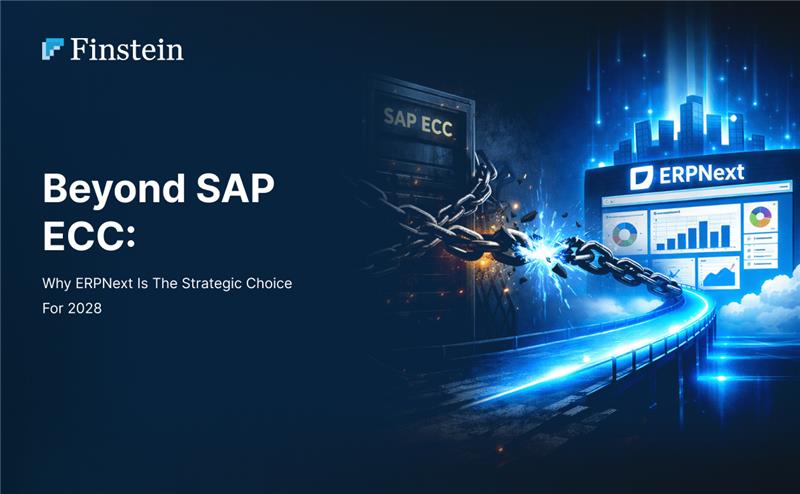
The ERP world is changing fast. SAP announced end-of-mainstream-maintenance for SAP Business Suite / ECC (core apps) on December 31, 2027 (with some older enhancement-package variants having earlier stop-dates), and vendors, implementers and customers are already scrambling.
That deadline is the catalyst many organizations need to stop treating ERP as “set-and-forget” and to pick a future-ready alternative that reduces cost, avoids vendor lock-in, and gives product teams the freedom to innovate. ERPNext — the open-source cloud ERP built on the Frappe framework — is a practical, enterprise-capable option with a growing track record of migrations from legacy systems. In this article I’ll explain why ERPNext, how to migrate from SAP ECC, typical timelines, risks and mitigations, and next steps (including resources you can use right away).
The 5-point case for ERPNext over staying on ECC
- You won’t be forced into expensive, long vendor migrations just because of a deadline. SAP’s ECC maintenance ends 2027 (some older EHPs already lost lifelines in 2025), which creates real cost and support risk.
- ERPNext is truly open-source — no per-user license fees: that materially lowers Total Cost of Ownership (TCO).
- Fast time to value & easier customization: Frappe’s Python + web stack makes functional changes and integrations faster and less expensive than typical SAP development cycles.
- Modern cloud-first UX, modules out-of-the-box (finance, MFG, inventory, HR, CRM): reduces configuration and training overhead versus heavy SAP landscapes.
- Proven migration patterns & community tooling: there are guides, migration projects and vendor partners who have migrated from SAP to ERPNext (so you’re not experimenting with untested approaches).
Why now — the SAP ECC timing reality
- SAP’s official stance: mainstream maintenance for Business Suite (ECC core) runs through Dec 31, 2027 (with optional extended maintenance to 2030 in some cases). That means security patches, bug fixes and official support taper off after that date — a real operational risk for mission-critical applications.
- Some ECC versions (EHP 0–5) already face earlier cut-offs (Dec 31, 2025). If you’re unsure which EHP your landscape runs, treat the date as urgent: migration planning must start now.
Why ERPNext is a practical destination for SAP customers
Open-source economics & transparency
ERPNext is GPL-licensed and has no “per-user” licensing model. For companies with many users (sales, shop-floor, accounting, purchasing, logistics), that removes a huge recurring cost line and makes scaling predictable.
Feature coverage for enterprise needs
ERPNext provides built-in modules for:
- Financials & multi-currency accounting
- Manufacturing (BOM, work orders, MRP)
- Inventory & warehouse management
- Purchasing & procurement workflows
- HR & payroll (with localization options)
- CRM, Projects and Helpdesk
This means you can map most SAP functional footprints to ERPNext with configuration and a manageable set of customizations.
Lower TCO and easier upgrades
Open code + cloud hosting (self-host or managed cloud) reduces both licensing and upgrade friction; you control the cadence and cost of upgrades rather than being forced into expensive, multi-year vendor upgrade projects.
Customization & integration speed
ERPNext runs on Python + MariaDB with a REST API — a modern developer stack that makes integration (IoT, MES, banking, custom reporting) faster and cheaper than bespoke SAP ABAP/PI landscapes. The community and ecosystem provide prebuilt connectors and migration helpers.
Realistic migration approach (high level)
Migrating an enterprise from SAP ECC is not a “lift-and-shift”. Do it in phases:
- Assessment & scope mapping (4–8 weeks)
- Inventory SAP modules in use, interfaces, custom code (Z-programs), third-party add-ons.
- Identify “must-have” processes vs. “nice-to-have”.
- Produce a gap map: SAP process → ERPNext feature / customization.
- Pilot (2–4 months)
- Choose a low-risk area (for example, Procurement + Inventory or a subsidiary).
- Migrate master data, run parallel posting for a short period, validate transactions.
- Incremental cutovers by domain (6–18 months)
- Roll domains live in waves: finance, procurement, manufacturing, payroll, etc.
- Use integrations for systems you’re not ready to retire (logistics, legacy WMS).
- Full decommission & knowledge transfer (1–3 months)
- Freeze legacy workflows, run reconciliation cycles, retire SAP instances.
Typical overall duration: many ERP transformations take 12–18 months end-to-end; smaller phased projects can be faster. Plan for data cleanup, user training, and 2–3 reconciliation months after each wave.
Common migration challenges and how to beat them
- Data quality & master data mapping: clean data early. Build automated scripts to transform SAP master records to ERPNext formats; validate with users. (Mitigation: invest 15–20% of project time in data prep.)
- Complex custom reports or ABAP logic: rewrite critical ABAP logic as Python scripts or server actions in ERPNext; keep only the business rules, not line-by-line ABAP translation. (Mitigation: do a functional rewrite not a literal port.)
- Integrations to peripheral systems: use ERPNext REST APIs or middleware. Prioritize interfaces you must keep (banking, e-invoicing, MES). (Mitigation: run integrations in parallel during pilot.)
- Change management & training: SAP users are used to different UI/workflow metaphors — prepare tailored training & role-based sandbox environments. (Mitigation: allocate 10% of project budget to training and documentation.)
How ERPNext compares on the hard metrics enterprises care about
- Licensing & recurring costs: ERPNext removes per-user license fees; you’ll replace them with hosting and partner costs (predictable). Expect materially lower multi-year software spend.
- Time to implement & change: ERPNext’s simpler stack and fewer proprietary barriers shorten custom feature cycles.
- Security & support: with self-hosting or a managed ERPNext cloud partner you control patch windows and SLAs. For mission-critical needs, select an experienced managed-service partner and a robust backup/DR setup.
Illustrative Migration checklist
- Do an SAP footprint audit (modules, custom code, interfaces).
- Prioritize processes: decide what must move day-1 versus what can be delayed.
- Choose migration pattern: big-bang (risky) vs phased waves (recommended).
- Pick an implementation partner with ERPNext enterprise experience and SAP migration background.
- Plan data cleansing and reconciliation cycles.
- Run a pilot for critical finance or inventory flows.
- Train super-users early and produce role-based playbooks.
- Budget for integrations (banking, MES, e-invoicing).
- Establish rollback & parallel run plans for the first two months after go-live.
- Decommission SAP only after careful post-go-live maturity checks.
SAP ECC’s end-of-mainstream-maintenance timeline forces a decision: pay rising fees and tackle a long migration to S/4HANA, or re-think ERP strategy entirely. ERPNext gives enterprises a third way — modern, open, and business-friendly — letting you preserve critical processes, slash licensing costs, and be in control of your roadmap. If you value agility, predictability and ownership, the time to evaluate ERPNext is now.