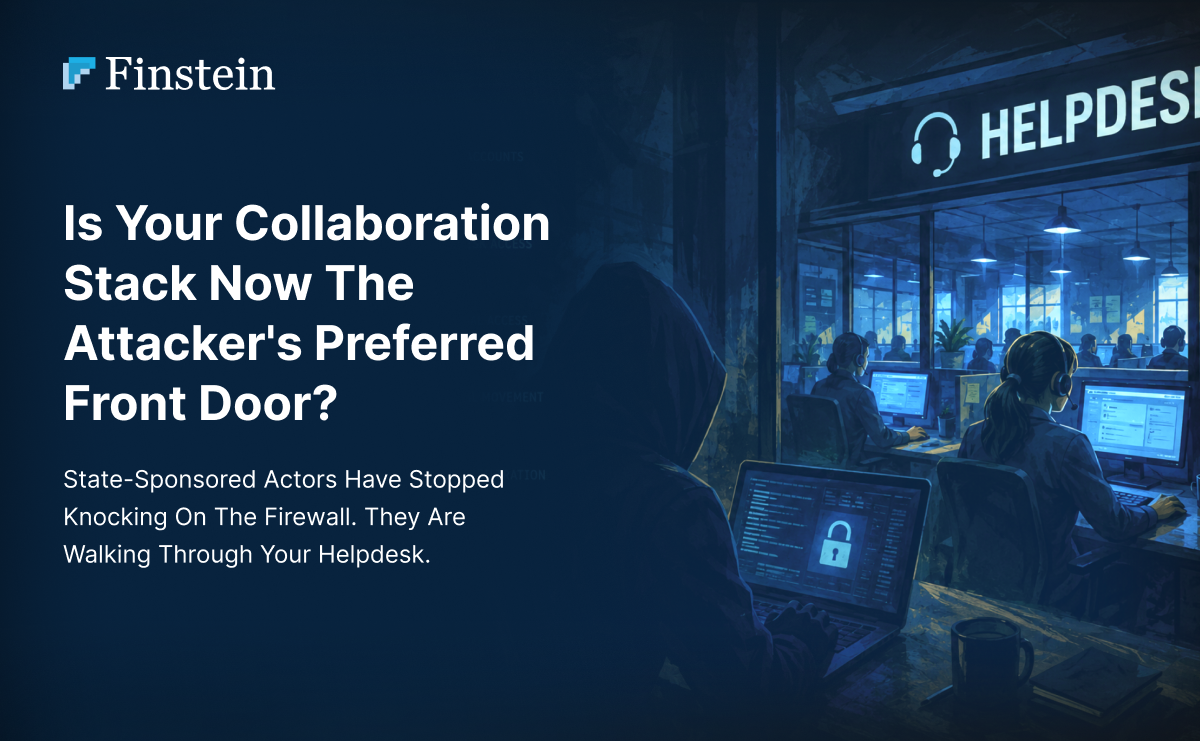
The most dangerous breach your organisation will face this year will not arrive through an unpatched server. It will arrive through a Microsoft Teams notification, dressed as an IT support request, carrying the implicit authority of your own enterprise infrastructure.
In early 2026, the Iranian state-sponsored group MuddyWater, also tracked as Mango Sandstorm and Seedworm, executed what researchers at Rapid7 have characterised as a “false flag” ransomware operation. The attack leveraged Microsoft Teams as a social engineering channel to initiate the infection sequence, while deliberately impersonating the Chaos ransomware-as-a-service brand to obscure its true, state-backed origins.
For CISOs and the advisory professionals who counsel them, this is not a technical footnote. This is a structural shift in how nation-state actors penetrate enterprise environments. The weapon of choice is no longer a zero-day. It is your employees’ reasonable, conditioned trust in the tools your organisation has sanctioned and deployed.
The reputational and fiduciary implications are significant. When a breach originates through a tool your board approved, your audit committee funded, and your compliance team cleared, the question shifts from “how did this happen” to “who was responsible for knowing this could happen.” That question lands squarely on leadership.
Four Strategic Realities This Attack Exposes
The technical sophistication of this campaign matters less than its strategic architecture. Understanding the layers is essential for any leader making investment and governance decisions.
Collaboration Platforms Are Now Primary Attack Surfaces
The campaign was characterised by a high-touch social engineering phase conducted via Microsoft Teams, where attackers used interactive screen-sharing sessions to harvest credentials and manipulate multi-factor authentication. MFA, which many organisations still treat as a near-complete control, was bypassed not by breaking cryptography but by watching a user type their credentials in real time. The trust model of a legitimate enterprise tool was the bypass.
The False Flag Doctrine: Attribution Chaos as a Strategic Weapon
Once inside, the group bypassed traditional ransomware workflows, forgoing file encryption entirely in favour of data exfiltration and long-term persistence via remote management tools like DWAgent. This is a critical strategic signal. The ransomware brand was deployed as theatre, not as the primary objective. The real objective was persistent, undetected access. For a finance firm or a professional services practice, persistent undetected access to client data represents an existential liability, not merely a recoverable incident.
The findings suggest that MuddyWater is increasingly relying on off-the-shelf tools from the cybercrime underground to conduct its attacks, a pattern documented by multiple research teams highlighting the adversary’s use of tools including CastleRAT and Tsundere. This convergence of state-sponsored intrusion activity and criminal tradecraft is specifically designed to delay attribution and slow the appropriate defensive response.
Extortion Has Become Multi-Dimensional
The Chaos RaaS group has demonstrated triple extortion by threatening distributed denial-of-service attacks against victims’ infrastructure, with these capabilities offered to affiliates as part of bundled services. The group has also been observed leveraging elements of quadruple extortion, including threats to contact customers or competitors to increase pressure on victims. For a law firm, an accounting practice, or a financial advisory, the threat of contacting your clients directly is not a technical risk. It is an existential one.
The Kinetic Threat Is No Longer Metaphorical
Check Point Research has noted that the cyber and kinetic domains are now explicitly connected, with stolen infrastructure data allegedly used to enable physical targeting. This campaign, according to researchers, is not slowing down. Boards and audit committees must now accept that certain cyber threats carry physical-world consequences. The governance conversation can no longer be confined to IT risk registers.
What Leadership Must Do Before the Next Notification Arrives
Re-Architect Trust for Collaboration Platforms
Microsoft Teams, Slack, Zoom, and similar tools were adopted for productivity. They were not designed to be zero-trust environments. Organisations must enforce strict external communication policies: limit or disable external chat requests by default, require explicit employee verification before any screen-sharing session, and deploy behavioural analytics to flag anomalous communication patterns. The internal helpdesk impersonation vector used by MuddyWater exploits the absence of a clear verification protocol. Establish one.
Move Beyond MFA Compliance to MFA Resilience
Ticking the MFA box on a compliance checklist does not protect you from real-time credential harvesting. Leaders must invest in phishing-resistant MFA at a minimum, specifically FIDO2 hardware keys or passkey-based authentication for privileged users and those with access to sensitive client data. Conditional access policies must be reviewed for gaps that allow unmanaged devices or unverified sessions.
Treat Remote Management Tools as a Governance Problem, Not an IT Problem
The threat actor used legitimate remote management tools such as DWAgent and AnyDesk to establish persistence, conducting reconnaissance, lateral movement, and data exfiltration using compromised user accounts. This is a governance failure, not merely a technical one. Every sanctioned remote access tool in your environment must be logged, scoped, and monitored. Unsanctioned installations of tools like AnyDesk or TeamViewer by non-IT personnel must trigger an immediate alert. Continuous asset discovery and privileged access reviews are not optional hygiene. They are board-level risk controls.
Invest in Threat-Intelligence-Driven Detection, Not Just Signature-Based Defence
The malware used in this campaign, specifically the Stagecomp loader and the Darkcomp RAT, masqueraded as legitimate Microsoft components. Signature-based detection would not reliably catch this. The Darkcomp RAT masquerades as a legitimate Microsoft WebView2 application and is a trojanised version of the official Microsoft WebView2 project. Behavioural detection, network traffic analysis, and deception technologies are required to surface this class of threat. Threat intelligence feeds tied to known Iranian-affiliated indicators of compromise must be operationalised, not filed in a report.
Where Finstein Meets This Moment
The MuddyWater campaign illustrates precisely why cybersecurity cannot be managed as a periodic compliance exercise. It demands continuous, intelligence-driven advisory supported by technical rigour. Finstein’s Cyber Advisory practice is designed for exactly this environment.
Cyber Advisory: Finstein’s advisors work directly with CISOs, executive leadership, and board-level stakeholders to translate threat intelligence, such as the MuddyWater attack pattern, into governance decisions and investment priorities. We help you ask the right questions before an incident forces the issue.
Vulnerability Assessment and Penetration Testing (VAPT): The attack surface exploited in this campaign, including Teams configurations, MFA implementations, and remote access tool deployments, can be systematically assessed and hardened. Finstein’s VAPT engagements are designed to simulate real-world adversarial behaviour, including the social engineering vectors increasingly used by state-linked threat actors.
Maturity Assessments: Many organisations do not yet know where they stand relative to the threats they face. Finstein’s Maturity Assessments benchmark your current capabilities against recognised frameworks and the specific threat landscape your sector faces, identifying critical gaps before adversaries find them.
AI-Driven Threat Intelligence: Finstein’s AI-driven threat intelligence capabilities enable continuous monitoring of adversary infrastructure, tactics, and evolving toolsets, including those tied to MuddyWater and its affiliates. You receive actionable, contextualised intelligence rather than raw data feeds that your team lacks the bandwidth to process.
The convergence of state-sponsored intent with criminal-grade tooling means the window between awareness and exploitation is shrinking. Your advisory posture must match that pace.
The Question Your Board Cannot Afford to Defer
The question facing every CISO and every professional services leader today is straightforward: are you governing your organisation’s trust infrastructure, or are your adversaries?
To begin a strategic conversation about your organisation’s cyber resilience, visit Finstein at https://cyber.finstein.ai. Our team is ready to assess where you stand and what you need to close the gap.
#Finstein #CyberSecurity #CISO #MicrosoftTeams #SocialEngineering #ThreatIntelligence #Ransomware #IdentitySecurity #ZeroTrust #StateSponsored #CyberResilience #InfoSec #DataProtection #CyberAdvisory #VAPT #MFA #ProfessionalServices #RiskManagement #CorporateGovernance #DigitalTrust