Skip to content
Blogs

Blogs

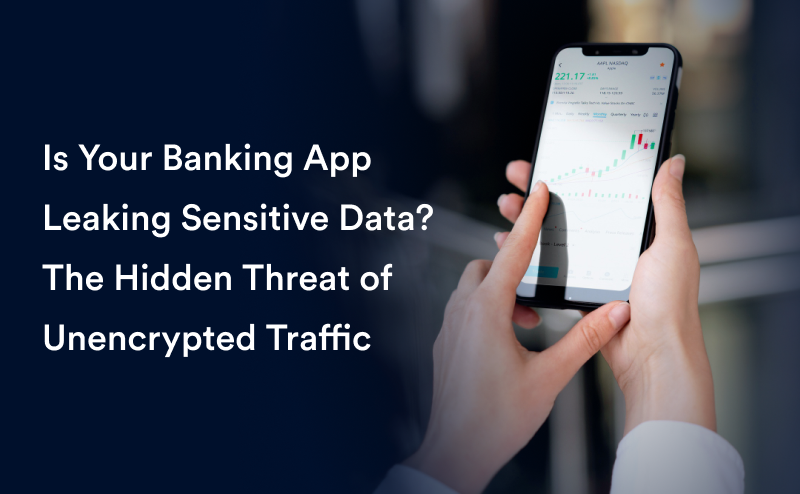
Is Your Banking App Leaking Sensitive Data? The Hidden Threat of Unencrypted Traffic

Posted on September 3, 2025September 27, 2025 By Finstein.ai No Comments on Is Your Banking App Leaking Sensitive Data? The Hidden Threat of Unencrypted Traffic

In an era where digital payments and mobile banking dominate, even a minor configuration slip in your financial app can expose millions to silent, invisible cyberattacks. A recent vulnerability (CVE-2025–45080) has brought this threat into sharp focus, especially for Android users relying on mobile apps for secure transactions.

The Vulnerability That Slipped Through

Security researchers uncovered a severe misconfiguration in a popular banking app’s Android version. Despite Android 9+ enforcing secure traffic rules by default, this app bypassed them with a simple but dangerous tag:

xmlCopyEditandroid:usesCleartextTraffic="true"

What does that mean?

It means the app allowed unencrypted HTTP connections even over open Wi-Fi or unsecured networks, leaving critical data like credentials and transaction details vulnerable to Man-in-the-Middle (MITM) attacks.

Why This Is a Big Deal

This isn’t just about bad coding. It’s about how a single overlooked line in the app’s configuration can:

  • Leak login credentials
  • Expose account numbers and balances
  • Allow attackers to hijack sessions or inject malicious responses
  • Lead to identity theft or unauthorized transactions

Even more alarming? Users might not even realize they’re being watched.

How Attackers Exploit This

Here’s how an attacker could abuse this flaw:

  • They install or decompile the app and see it allows cleartext traffic.
  • They wait at your local café’s public Wi-Fi, set up a proxy or fake access point.
  • You open your banking app. It sends data over HTTP. The attacker sniffs, reads, or alters it.
  • Boom your session is compromised, and you never saw it coming.

No malware. No clicks. Just traffic interception.

What Should Be Done Immediately?

For End Users:

  • Avoid using banking apps on public Wi-Fi.
  • Use mobile data whenever possible for sensitive transactions.
  • Keep your app updated. Patches may roll out quietly.
  • Enable SMS/email alerts to catch suspicious activity early.

For App Developers:

  • Set android:usesCleartextTraffic="false" in your AndroidManifest.xml.
  • Enforce HTTPS using Network Security Config.
  • Implement SSL pinning and endpoint validation.
  • Run regular mobile security audits and static code analysis.

What This Teaches Us About Security

Secure apps aren’t just about strong encryption algorithms. They’re about secure defaults, continuous validation, and developer awareness. In the world of banking, every packet counts because users trust you with their future.

In a digital world where one overlooked setting can lead to mass exposure, security must be part of the blueprint, not an afterthought.

Whether you’re a developer, a product manager, or a daily user of banking apps, understanding how data flows through your device is crucial.

“It’s just one line of code.” That’s how most breaches start.
Encryption isn’t optional. HTTPS isn’t a luxury. They are the minimum line of defense in a world of invisible threats.

Stay aware. Stay encrypted. Stay secure.
Banking Vulnerability Data

Data Sciences

Post navigation

Previous Post: When Isolation Fails: The Sudo + Chroot Vulnerability That Grants Root Access
Next Post: Is a Zero-Day Breach Lurking in Your Network? Nippon Steel Solutions Attack

Related Posts

Artificial Intelligence is transforming how businesses operate — from autonomous accounting to predictive manufacturing and AI-driven compliance. But here’s the uncomfortable truth: Most ERP systems were never designed for AI. At Finstein, after implementing ERP solutions across manufacturing, Services, SaaS, and compliance-heavy enterprises, we see one clear winner in the AI-first world: ERPNext And the biggest reason is something many organizations underestimate: The Source Code Is Open and That Changes Everything Open Source = AI Agent Freedom ERPNext is fully open-source. That means: Complete access to the source code Full database transparency Custom workflow modification at core level No dependency on vendor release cycles Now combine that with AI agents. In the AI era: AI doesn’t just analyze data AI modifies workflows AI optimizes business logic AI auto-corrects process gaps With closed ERPs, AI agents are restricted to surface-level automation. With ERPNext, AI agents can: Rewrite validation logic Create dynamic approval hierarchies Auto-design reports Modify costing structures Build self-learning MRP models Embed copilots directly into transactions This is not “integration.” This is deep system-level intelligence. And that is only possible because the source code is open. AI Should Sit Inside ERP, Not Outside It Most enterprises today are: ERP → Export Data → AI Tool → Manual Action → Re-upload That is inefficient. ERPNext allows: Native API access Python-level customization Direct database logic modification Event-based triggers for AI This enables: AI-driven journal validation Predictive MRP Smart compliance testing Real-time fraud flags Automated anomaly detection Dynamic risk scoring AI becomes embedded in the operational fabric. Cost of AI Innovation Is Radically Lower Large ERP vendors: Charge heavily for AI modules Restrict core customization Lock clients into upgrade dependencies ERPNext allows: Build-your-own AI apps Industry-specific extensions Rapid prototyping Low licensing overhead For SMEs and mid-sized enterprises, this democratizes AI. Data Ownership + Compliance Control In regulated sectors — especially: Banking & NBFCs Healthcare SaaS (SOC 2 environments) Manufacturing with audit requirements Data sovereignty matters. ERPNext allows: On-prem deployment Private cloud Full database access Security customization Audit-log enhancements AI can be implemented without compromising governance. Built for Continuous Evolution Because ERPNext runs on the Frappe framework: Developers can create custom apps rapidly AI microservices can be plugged in Workflow engines can be extended Industry-specific AI copilots can be deployed The system evolves with the business. Not the other way around. The Finstein View We see a structural shift happening. The future ERP is not the one with the most modules. The future ERP is the one that: AI agents can understand AI agents can modify AI agents can optimize AI agents can extend And that requires open source. Final Thought AI will not replace ERP systems. But AI-enabled, open-source ERP systems will replace rigid, closed ones. If your ERP system cannot be intelligently modified by AI agents at the source-code level, you are building on a foundation designed for the past. ERPNext was built for adaptability. And in the AI era, adaptability wins. #ERPNext #OpenSourceERP #AIERP #ArtificialIntelligence #EnterpriseAI #DigitalTransformation #IntelligentAutomation #FinanceTransformation #ManufacturingERP #ComplianceAutomation #SOC2 #ISO27001 #FutureOfERP #FrappeFramework #SMEDigital #AITransformation #BusinessAutomation #Finstein Why ERPNext Is the Smartest ERP in the AI Era Data Sciences
The Blurred Line Between Corporate Management and Malware Cyber
Is Your Proprietary Code the New Ransomware Target Is Your Proprietary Code the New Ransomware Target? Ai
Your Firewall Will Fail. Is Your Recovery Ready? Your Firewall Will Fail. Is Your Recovery Ready? Cyber
Your Firewalls are Perfect, Your Employees are Not. Your Firewalls are Perfect, Your Employees are Not. Cyber
The Login That Lies The Login That Lies Ai

Leave a Reply Cancel reply

Your email address will not be published. Required fields are marked *

Categories

  • Ai
  • Cyber
  • Data Sciences
  • ERPNext
  • Technology

Copyright © 2026 Blogs.

Powered by PressBook Masonry Blogs