Skip to content
Blogs

Blogs

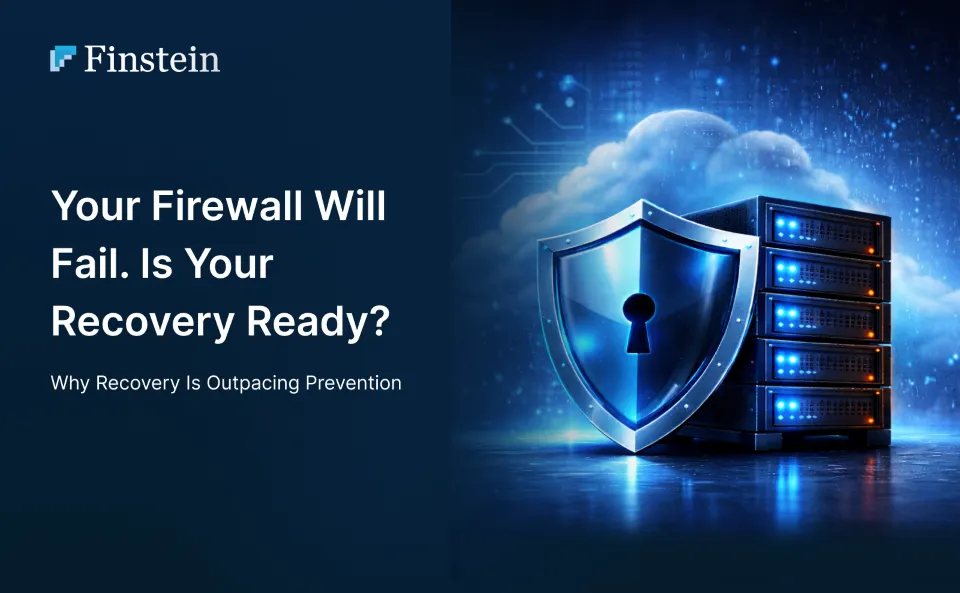
Your Firewall Will Fail. Is Your Recovery Ready?

Posted on February 24, 2026February 26, 2026 By Finstein.ai No Comments on Your Firewall Will Fail. Is Your Recovery Ready?
Your Firewall Will Fail. Is Your Recovery Ready?

For decades, the cybersecurity industry was built on a single promise: keeping the bad actors out. Organizations invested billions in digital walls, hoping that a strong enough perimeter would render them untouchable. However, as we move through 2026, the narrative has shifted fundamentally. Boards and IT leaders are now prioritizing incident recovery planning over pure prevention.

The reason is a sobering reality. In a world of AI-driven threats and hyper-connected supply chains, a 100% prevention rate is no longer a realistic goal rather it is a dangerous illusion.

The Reality of “When,” Not “If”

The focus on recovery is not a sign of defeat, but a mark of operational maturity. Several factors are driving this change in strategy:

  • The Sophistication of AI Attacks: Modern threats like synthetic phishing and automated botnets evolve faster than any static defense can be patched. When an attack can mutate in real-time, some breaches become statistically inevitable.
  • The Cost of Downtime: For a modern enterprise, an hour of system downtime can cost upwards of $100,000. While prevention tries to stop the clock from starting, recovery planning ensures the clock stops as quickly as possible.
  • Regulatory and Insurance Pressure: Cyber insurance providers and regulators are increasingly looking at “Forensic Readiness.” They are less interested in how many firewalls you have and more interested in how quickly you can detect, contain, and restore operations after a hit.
  • Complexity of the Attack Surface: With employees working from everywhere and data spread across dozens of cloud providers, the “perimeter” has effectively vanished. It is impossible to prevent an entry when there are thousands of doors to watch.

Why Recovery Often Wins the Budget

Incident recovery gets more attention because its results are measurable and visible. A prevented attack is a non-event that is hard to quantify, but a rapid recovery from a ransomware attempt is a documented save that protects the bottom line. Resilience has become the new competitive advantage.

Solutions and Precautions

To balance your strategy, you must move from a “fail-safe” mindset to a “safe-to-fail” one:

  • Immutable Backups: Ensure your data backups are isolated and cannot be encrypted or deleted by the same credentials used in your primary network.
  • Segmentation: Treat your network like a ship with watertight compartments. If one area is breached, the rest of the vessel should stay afloat.
  • Regular Drills: An incident recovery plan that has not been tested is just a document. Conduct tabletop exercises and “live fire” simulations to ensure your team knows their roles under pressure.

Finstein bridges the gap between prevention and resilience. While we offer robust Vulnerability Assessments and Penetration Testing (VAPT) to harden your defenses, we specialize in building the “Lifeboats” of your digital infrastructure.

Our Cyber advisory services help you design recovery playbooks that are tailored to your specific business logic. We leverage AI-driven behavioral recognition to detect anomalies at the earliest possible stage, allowing you to contain threats before they escalate into disasters. With Finstein, you aren’t just building a wall; you are building a resilient organization that can absorb a shock and keep moving forward.

The goal of modern security is no longer to be impenetrable, but to be unbreakable. By shifting your focus toward incident recovery, you acknowledge that while you cannot control the attackers, you can absolutely control your response.

Don’t wait for a breach to find the gaps in your recovery plan.

Reach out to our experts at https://cyber.finstein.ai

#CyberSecurity #IncidentResponse #BusinessContinuity #Finstein #CyberResilience #InfoSec #TechLeadership #DataRecovery #CyberInsurance #RiskManagement
Cyber, Data Sciences

Post navigation

Previous Post: Your Firewalls are Perfect, Your Employees are Not.
Next Post: Why Finance Teams Choose ERPNext Over Legacy Systems

Related Posts

Artificial Intelligence is transforming how businesses operate — from autonomous accounting to predictive manufacturing and AI-driven compliance. But here’s the uncomfortable truth: Most ERP systems were never designed for AI. At Finstein, after implementing ERP solutions across manufacturing, Services, SaaS, and compliance-heavy enterprises, we see one clear winner in the AI-first world: ERPNext And the biggest reason is something many organizations underestimate: The Source Code Is Open and That Changes Everything Open Source = AI Agent Freedom ERPNext is fully open-source. That means: Complete access to the source code Full database transparency Custom workflow modification at core level No dependency on vendor release cycles Now combine that with AI agents. In the AI era: AI doesn’t just analyze data AI modifies workflows AI optimizes business logic AI auto-corrects process gaps With closed ERPs, AI agents are restricted to surface-level automation. With ERPNext, AI agents can: Rewrite validation logic Create dynamic approval hierarchies Auto-design reports Modify costing structures Build self-learning MRP models Embed copilots directly into transactions This is not “integration.” This is deep system-level intelligence. And that is only possible because the source code is open. AI Should Sit Inside ERP, Not Outside It Most enterprises today are: ERP → Export Data → AI Tool → Manual Action → Re-upload That is inefficient. ERPNext allows: Native API access Python-level customization Direct database logic modification Event-based triggers for AI This enables: AI-driven journal validation Predictive MRP Smart compliance testing Real-time fraud flags Automated anomaly detection Dynamic risk scoring AI becomes embedded in the operational fabric. Cost of AI Innovation Is Radically Lower Large ERP vendors: Charge heavily for AI modules Restrict core customization Lock clients into upgrade dependencies ERPNext allows: Build-your-own AI apps Industry-specific extensions Rapid prototyping Low licensing overhead For SMEs and mid-sized enterprises, this democratizes AI. Data Ownership + Compliance Control In regulated sectors — especially: Banking & NBFCs Healthcare SaaS (SOC 2 environments) Manufacturing with audit requirements Data sovereignty matters. ERPNext allows: On-prem deployment Private cloud Full database access Security customization Audit-log enhancements AI can be implemented without compromising governance. Built for Continuous Evolution Because ERPNext runs on the Frappe framework: Developers can create custom apps rapidly AI microservices can be plugged in Workflow engines can be extended Industry-specific AI copilots can be deployed The system evolves with the business. Not the other way around. The Finstein View We see a structural shift happening. The future ERP is not the one with the most modules. The future ERP is the one that: AI agents can understand AI agents can modify AI agents can optimize AI agents can extend And that requires open source. Final Thought AI will not replace ERP systems. But AI-enabled, open-source ERP systems will replace rigid, closed ones. If your ERP system cannot be intelligently modified by AI agents at the source-code level, you are building on a foundation designed for the past. ERPNext was built for adaptability. And in the AI era, adaptability wins. #ERPNext #OpenSourceERP #AIERP #ArtificialIntelligence #EnterpriseAI #DigitalTransformation #IntelligentAutomation #FinanceTransformation #ManufacturingERP #ComplianceAutomation #SOC2 #ISO27001 #FutureOfERP #FrappeFramework #SMEDigital #AITransformation #BusinessAutomation #Finstein Why ERPNext Is the Smartest ERP in the AI Era Data Sciences
The Blurred Line Between Corporate Management and Malware Cyber
Is Your Proprietary Code the New Ransomware Target Is Your Proprietary Code the New Ransomware Target? Ai
Your Firewalls are Perfect, Your Employees are Not. Your Firewalls are Perfect, Your Employees are Not. Cyber
The Login That Lies The Login That Lies Ai
Why Being a “Good Employee” Makes You Easier to Phish. Why Being a “Good Employee” Makes You Easier to Phish. Cyber

Leave a Reply Cancel reply

Your email address will not be published. Required fields are marked *

Categories

  • Ai
  • Cyber
  • Data Sciences
  • ERPNext
  • Technology

Copyright © 2026 Blogs.

Powered by PressBook Masonry Blogs