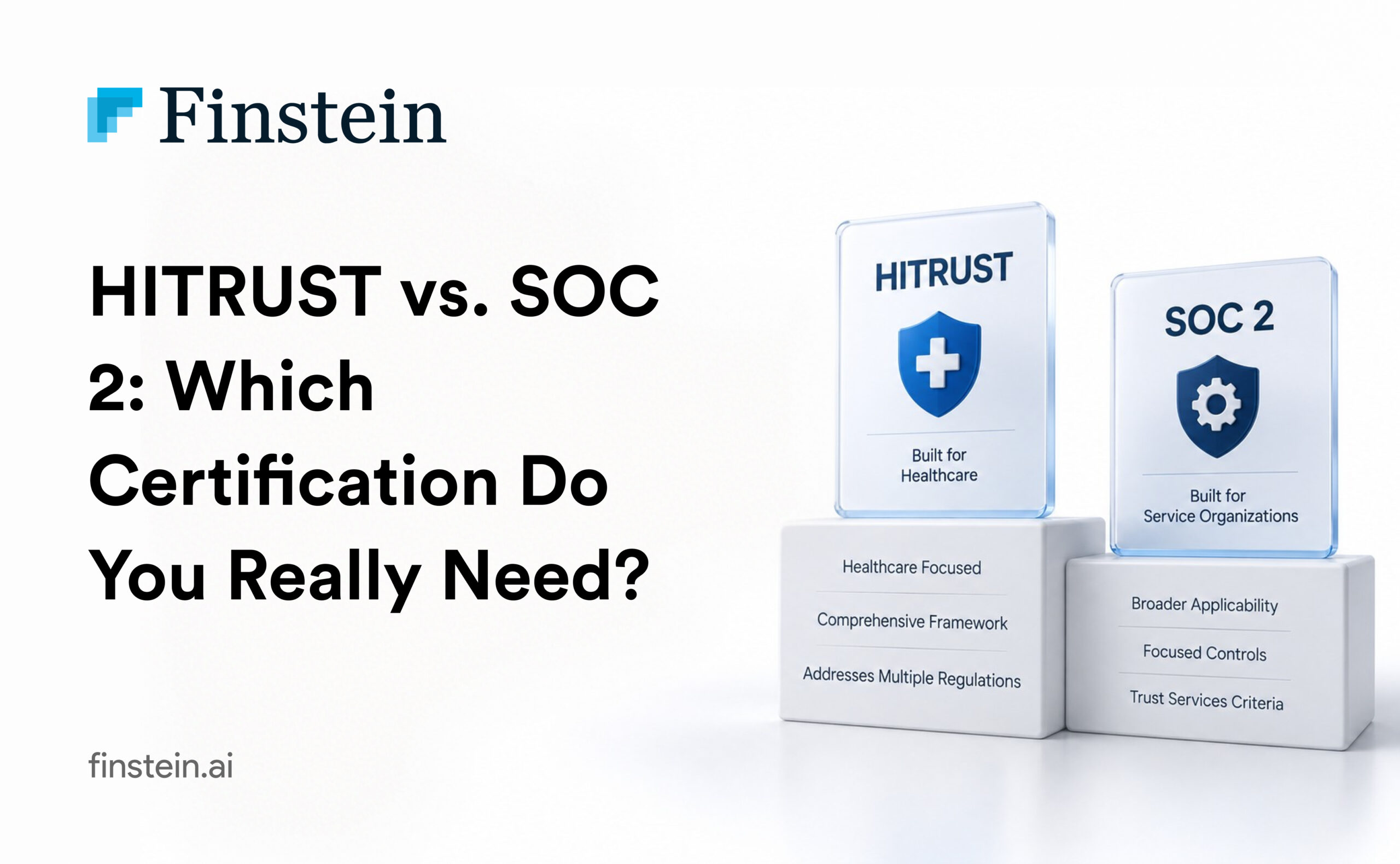
SOC 2 is a flexible attestation report issued by a CPA firm against the AICPA Trust Services Criteria. HITRUST is a prescriptive, scored certification issued by HITRUST against the HITRUST CSF. Choose SOC 2 for broad SaaS and enterprise buyers. Choose HITRUST when selling to US payers, health systems or anyone handling large PHI volumes. Many healthcare vendors eventually hold both.
What is SOC 2?
SOC 2 (System and Organization Controls 2) is an attestation framework owned by the American Institute of Certified Public Accountants (AICPA). An independent CPA firm examines your controls against the Trust Services Criteria: Security (mandatory), and optionally Availability, Processing Integrity, Confidentiality and Privacy.
- Type 1 reports on control design at a point in time.
- Type 2 reports on design and operating effectiveness over a period, usually 6 to 12 months.
Critically, SOC 2 is not a certification. It is an auditor’s opinion. The organisation defines its own controls to meet the criteria, and the auditor tests those controls. There is no pass mark. Reports can include exceptions and still be issued.
What is HITRUST?
HITRUST certification is issued by the HITRUST Alliance after an Authorized External Assessor tests your environment against the HITRUST CSF, a control library harmonising HIPAA, NIST, ISO 27001, PCI DSS and more than 50 other sources.
- Requirements are prescribed by HITRUST, not written by the organisation.
- Each requirement is scored. e1 and i1 require a minimum score of 83 in every domain. r2 requires 62 in every domain, measured across five maturity levels.
- HITRUST performs its own quality assurance on the assessor’s work before issuing certification.
- Three levels exist: e1 (around 44 requirements), i1 (around 180) and r2 (tailored, typically several hundred).
HITRUST vs SOC 2: what are the key differences?
| Dimension | SOC 2 | HITRUST |
| Owner | AICPA | HITRUST Alliance |
| Output | Attestation report with auditor’s opinion | Certification letter and scored report |
| Who performs it | Licensed CPA firm | HITRUST Authorized External Assessor, then HITRUST QA |
| Control definition | Organisation defines controls to meet criteria | HITRUST prescribes requirement statements |
| Pass or fail | No pass mark. Opinion can be qualified | Scored. Minimum domain thresholds must be met |
| Scope flexibility | High | Moderate (e1, i1 fixed sets; r2 risk-tailored) |
| Healthcare specificity | Generic. HIPAA mapping optional | Built around HIPAA and PHI protection |
| Maturity measurement | Operating effectiveness only | r2 scores policy, procedure, implemented, measured, managed |
| Validity | Report covers a past period, refreshed annually | e1 and i1: 1 year. r2: 2 years with interim assessment |
| Typical first-time timeline | 3 to 9 months | e1: 3 to 5 months. i1: 5 to 9. r2: 9 to 15 |
| Relative cost | Lower | e1 comparable to SOC 2. i1 and r2 higher |
| Buyer recognition | Universal across SaaS and enterprise | Strongest in US healthcare, growing elsewhere |
| Inheritance from cloud providers | Carve-out or inclusive method for subservice organisations | Formal inheritance of scores through MyCSF |
Which one is more rigorous?
On a like-for-like basis, HITRUST i1 and r2 are more rigorous than a typical SOC 2 Type 2, for three reasons:
1. Prescriptive requirements remove the organisation’s ability to define lenient controls.
2. Quantitative scoring with minimum thresholds means weak areas cannot be hidden in narrative.
3. Centralised QA by HITRUST applies a consistent standard across all assessor firms.
This does not make SOC 2 weak. A well-scoped SOC 2 Type 2 from a reputable firm is strong assurance. The difference is consistency: two SOC 2 reports can vary widely in depth, while two HITRUST i1 certifications cover the same requirement set.
A HITRUST e1, by contrast, is a foundational hygiene assessment and is narrower than most SOC 2 Type 2 reports.
Which one do your customers actually want?
| Your buyer | What they usually ask for |
| US payers, PBMs, large health systems | HITRUST r2 or i1 |
| Mid-market healthcare providers and health tech platforms | HITRUST i1 or e1, or SOC 2 Type 2 with HIPAA mapping |
| General enterprise SaaS buyers | SOC 2 Type 2 |
| Financial services | SOC 2 Type 2, sometimes SOC 1 for financial reporting controls |
| European and Asian enterprises | ISO/IEC 27001, often with SOC 2 |
| Indian GCCs and IT/ITeS serving US healthcare clients | HITRUST plus SOC 2 |
The practical rule: follow the contract, not the trend. Review your top 10 customers and top 10 prospects, record what each asks for, and let that matrix decide.
Is SOC 2 enough for HIPAA compliance?
SOC 2 can include HIPAA mapping, and a SOC 2 + HIPAA report is useful evidence. However, SOC 2 criteria were not designed around the HIPAA Security Rule, and neither SOC 2 nor HITRUST makes an organisation “HIPAA certified”, because no such official certification exists. HITRUST integrates HIPAA requirements directly into its control set, which is why healthcare buyers treat it as the closer proxy.
Can you reuse SOC 2 work for HITRUST?
Yes, substantially. Organisations with a mature SOC 2 Type 2 typically find that a large share of e1 requirements and a meaningful portion of i1 requirements are already evidenced. Common reusable areas:
- Access management and MFA
- Change management
- Logging and monitoring
- Vendor management
- Incident response
- HR security and awareness training
- Backup and recovery
Common gaps when moving from SOC 2 to HITRUST:
- Prescriptive configuration standards and hardening
- Formal risk management programme documentation
- Media handling and physical security detail
- Privacy-specific requirements
- For r2: documented policy and procedure for every requirement, plus measurement
Do you need both?
Many healthcare-facing vendors do. There are two efficient ways to get there:
1. Sequential. SOC 2 Type 2 first for broad market access, then HITRUST e1 or i1 when healthcare enterprise demand materialises.
2. Combined. A single evidence collection cycle feeding both the SOC 2 examination and the HITRUST validated assessment. The AICPA and HITRUST have published mapping between the Trust Services Criteria and the CSF, and a SOC 2 report can be issued using HITRUST CSF controls as the basis.
A provider that delivers both SOC reporting and HITRUST assessment can align fieldwork windows and sampling, which reduces duplicated requests to control owners.
Decision matrix
| If this is true | Then choose |
| No PHI, general B2B SaaS | SOC 2 Type 2 |
| Some PHI, mid-market healthcare buyers, limited budget | SOC 2 Type 2 with HIPAA mapping, or HITRUST e1 |
| PHI at scale, contract names HITRUST | HITRUST i1 or r2, as specified |
| Selling to both healthcare and non-healthcare enterprises | SOC 2 Type 2 plus HITRUST i1 |
| Global customers including EU | ISO 27001 plus SOC 2, add HITRUST for US healthcare |
| Already SOC 2, healthcare pipeline growing | Add HITRUST e1 or i1, reusing SOC 2 evidence |
Key takeaways
- SOC 2 is an attestation. HITRUST is a certification.
- SOC 2 lets you define controls. HITRUST prescribes and scores them.
- HITRUST carries more weight with US payers and health systems. SOC 2 is the universal SaaS baseline.
- SOC 2 evidence can be reused for HITRUST, reducing effort.
- Let customer contracts, not opinion, decide the sequence.
Frequently asked questions
Is HITRUST harder than SOC 2?
HITRUST i1 and r2 are generally harder because requirements are prescribed, scored against thresholds and reviewed by HITRUST QA. HITRUST e1 is comparable to or lighter than a SOC 2 Type 2.
Does HITRUST replace SOC 2?
Not usually. Non-healthcare buyers still ask for SOC 2. Many vendors maintain both.
Is SOC 2 a certification?
No. SOC 2 is an attestation report containing a CPA firm’s opinion. There is no SOC 2 certificate.
Can one firm do both SOC 2 and HITRUST?
Yes, provided the firm is a HITRUST Authorized External Assessor and the SOC 2 opinion is issued by a licensed CPA firm.
Which is faster to obtain?
A SOC 2 Type 1 or a HITRUST e1 are the fastest, often achievable in three to five months.
About Finstein
Finstein delivers SOC 1 and SOC 2 reporting support and is a HITRUST Authorized External Assessor, with CCSFP, CHQP, CISA and ISO 27001 lead auditor qualified teams. We help vendors build one control set and one evidence library that serves both. Book a framework selection call and leave with a customer-driven recommendation.
HITRUST #HITRUSTCSF #HITRUSTCertification #HealthcareCybersecurity #HealthcareCompliance #HIPAA #HIPAACompliance #Cybersecurity #DataSecurity #InformationSecurity #RiskManagement #ThirdPartyRisk #VendorRiskManagement #HealthcareIT #HealthTech #PHI #DataPrivacy #Compliance #GRC #CyberRisk #SOC2 #ISO27001 #NIST #BusinessAssociates #HealthcareTechnology