The boardroom question nobody asks
Boards spend hours debating ERP investment decisions. Should we move to S/4HANA? Is Oracle Fusion the right call? What’s the case for Dynamics 365? Cloud or hybrid? Greenfield or brownfield migration?
What boards almost never ask is the question that matters more than any of these:
How much of the ERP we already own are we actually using?
Across most enterprises, the honest answer is uncomfortable. Industry data suggests only around 26% of employees in a typical organisation use the ERP actively. Module-level adoption tells a similar story — finance and basic operations are well-embedded, while procurement, HR, supply chain analytics, risk, and workflow automation often sit dormant. If your platform offers twenty modules, you are likely getting meaningful value from eight to ten.
ERP ownership — licences, infrastructure, partner support, internal IT effort — typically runs between two and five percent of annual revenue for a mid-to-large enterprise. That is a material line on the P&L. And yet the conversation about return rarely moves past “the system is live.”
That is the silent leak. And it is structural, not tactical.
The paradox: why ROI looks fine on paper
Here is what makes this problem so insidious: most ERP programs do report success.
Roughly two-thirds of organisations report efficiency improvements after implementation, and a substantial majority say they meet ROI expectations on paper. So if the spreadsheet says the system pays for itself, where is the problem?
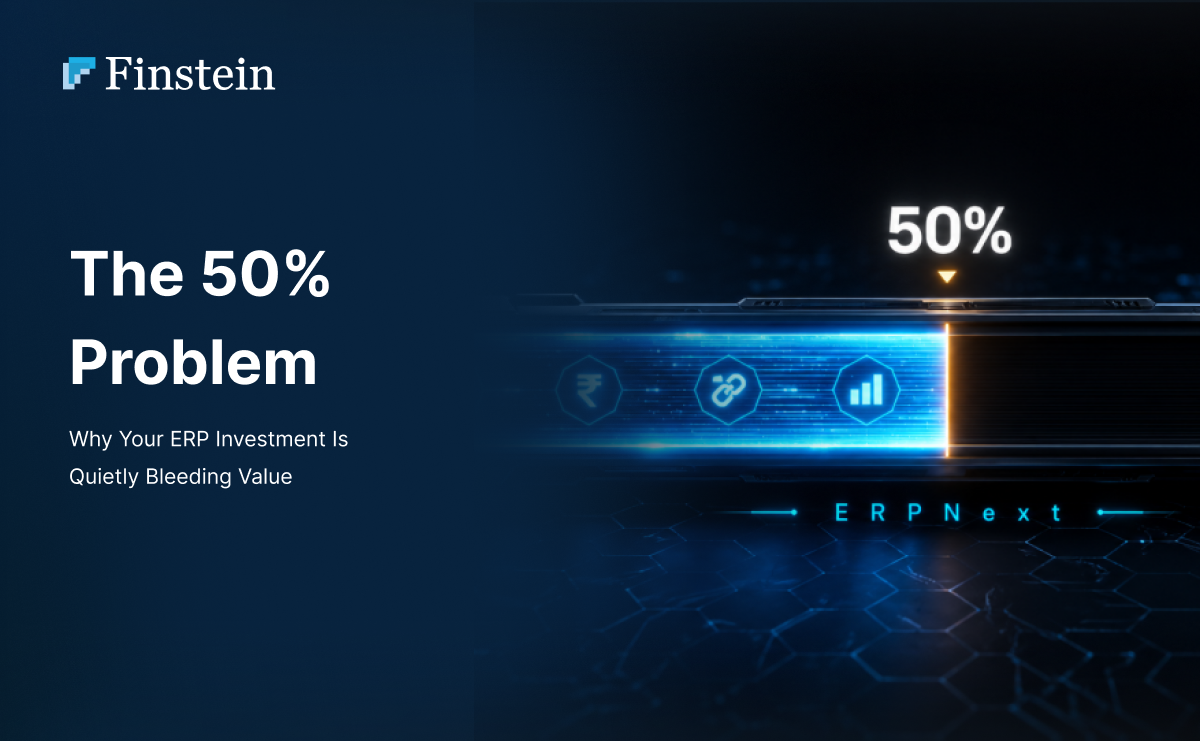
The problem is that ROI is being achieved despite underutilisation, not because of optimisation. The early wins from any ERP rollout — retiring legacy systems, automating month-end close, standardising master data, eliminating duplicate finance spreadsheets — are large enough to clear the ROI bar even when 40 to 60 percent of the platform’s capability is sitting unused.
The ROI you are reporting today is not the ceiling. It is the floor.
There is a second tier of value, often equal to or greater than what has already been captured, that the system is fully capable of delivering — and isn’t. Real-time profitability by SKU. Predictive cash flow. Workflow automation across procure-to-pay. Embedded analytics inside operational decisions. Risk and compliance built into transactions rather than reconciled after them. Most enterprises have paid for these capabilities. Few are using them.
The strategic differentiation lives in that second tier. Most companies never reach it.
Where utilisation actually breaks down
In our work with banks, NBFCs, and enterprise clients, ERP underutilisation is almost never a single failure. It is the cumulative effect of five distinct gaps, each compounding the others.
Module fragmentation. Finance and accounting go live, prove their value quickly, and become the de facto definition of “the ERP.” Procurement, HR, asset management, and analytics modules get scoped into Phase 2 — and Phase 2 quietly never starts. The platform was bought and configured as an integrated suite. It operates as a set of silos.
Feature blindness. Even within active modules, most organisations use a thin slice of available functionality. Workflow engines remain unconfigured. Approval matrices stay static. Predictive features, simulation tools, and built-in analytics dashboards go untouched — not because they are bad, but because nobody knew they existed or had the time to turn them on. These are not premium add-ons. They are paid-for capabilities hidden behind a configuration screen.
Licence-to-usage mismatch. Procurement buys licences based on headcount. Actual usage tracks much lower. It is common to see organisations paying for a thousand named users when active monthly users number three to four hundred. The gap is not a forecasting error. It is a signal that the system never landed with the people it was meant to serve.
Shadow systems. Despite the ERP, Excel persists. So do email-driven approvals, locally maintained trackers, and side databases that follow the original Excel logic dressed up as Access or SharePoint. These shadow systems are not user defiance. They are a diagnostic. Every one of them is a place where the ERP, as configured, did not solve the user’s real problem. Counting them is one of the fastest ways to size the utilisation gap.
Process misalignment. This is the deepest gap. ERPs are typically configured around how the system expects work to flow, not how the business actually operates. Implementation teams choose between two bad options: customise heavily to fit the business and accept the maintenance burden, or force the business to adapt and accept low adoption. Both paths lead to underutilisation — one through complexity, the other through resistance.
These failures interact. Shadow systems reinforce module fragmentation. Process misalignment drives feature blindness. Licence excess masks adoption gaps. The result is a system that is technically operational but strategically dormant.
What 50% utilisation actually costs
Consider a mid-sized enterprise spending ₹10 crore a year on ERP — licences, infrastructure, partner support, and internal IT effort combined. At 50% utilisation, the direct cost of waste is ₹5 crore annually.
But the direct cost is the smaller number.
The larger number is opportunity cost: decisions made on incomplete data, working capital trapped because procurement and finance don’t talk in real time, customer service gaps because CRM and order management aren’t integrated, compliance risk because controls live in spreadsheets rather than in the system of record.
Add opportunity cost to direct cost, and the true loss from underutilisation in many enterprises exceeds the original investment. The ERP stops being merely an underperforming asset and becomes a cap on enterprise performance.
Why this happens: the structural causes
Underutilisation is not a tactical problem. It is the predictable output of how most enterprises approach ERP. Four structural patterns explain almost every case.
ERP is treated as an IT project, not a business transformation. When the program lives inside the CIO’s organisation, the success metrics become technical: go-live date, uptime, ticket resolution. Business outcomes — cycle-time reduction, working capital release, decision velocity — stay aspirational in the slide deck rather than becoming measured commitments. Once the system is live, IT pivots to support mode, and nobody owns the next phase of value capture.
Training is treated as an event, not a capability. Most rollouts compress training into the weeks before go-live. Six months later, the people who were trained have moved roles, the people who replaced them learned the system from a colleague over coffee, and institutional knowledge of the platform’s deeper capabilities has evaporated. There is no continuous learning function tied to the ERP, the way there is for safety, compliance, or customer service.
Nobody owns utilisation. The CIO owns the system. Business heads own their processes. Finance owns the budget. Utilisation sits in the gap between all three. Without a single accountable owner — and a metric they are measured on — utilisation is everyone’s concern and nobody’s job.
The implementation partner is incentivised for go-live, not adoption. System integrators are paid to deliver a working system on time. Their commercial model rarely extends to driving usage twelve months in. By the time underutilisation becomes visible — typically twelve to eighteen months post go-live — the implementation team has rotated out, and re-engaging them is treated as a new project rather than the continuation of an unfinished one.
None of these are failures of effort or intent. They are the predictable output of how the work is structured. Until the structure changes, the outcome won’t.
The ERP Utilisation Index: making the invisible measurable
You cannot manage what you do not measure. Most organisations do not measure ERP utilisation in any consistent way. The first step toward closing the gap is making it visible.
The framework we use with clients is an ERP Utilisation Index (EUI) — a composite metric that brings together the dimensions of utilisation that actually matter:
- User adoption — active users as a percentage of licensed users, tracked monthly, segmented by module and business unit. This single number simultaneously exposes licence waste and adoption failure.
- Module utilisation — the percentage of purchased modules in active business use, weighted by their criticality to the business model. A 90% module utilisation rate that excludes the supply chain module in a manufacturing business is not really 90%.
- Feature utilisation — within each active module, the percentage of available features that are configured and used. This is the least visible gap, and often the largest.
- Process coverage — the percentage of end-to-end business processes executed entirely within the ERP, versus processes that involve handoffs to spreadsheets, email, or shadow systems.
- Automation index — the percentage of workflows running on system-driven automation versus manual approvals and interventions.
A composite EUI gives the executive team a single number they can track quarter over quarter, the same way they track NPS or working capital days. More importantly, it reframes the ERP conversation from a one-time project to an ongoing performance discipline — which is what it should have been from day one.
What leading organisations do differently
The enterprises that are extracting full value from their ERP investments share a common operating model. They treat ERP as a living system, not a finished implementation.
They run quarterly utilisation audits, not annual reviews. They map business KPIs to specific ERP capabilities, so that when a metric underperforms, the ERP is examined as part of the diagnosis rather than a separate technical conversation. They re-engineer processes continuously rather than locking in the initial design. They measure ROI at the module level, not the platform level. And critically, they invest in an internal ERP Centre of Excellence — a small, permanent team whose mandate is to drive utilisation, run continuous training, and keep the system aligned with where the business is going.
None of this requires new technology. All of it requires new discipline.
A diagnostic for CEOs and CIOs
Before approving the next ERP-related investment — a new module, a cloud migration, an AI overlay — leadership should be able to answer five questions cleanly:
- How many of our licensed users were active in the system last month?
- How many of our purchased modules are in full business use?
- Which core processes still run primarily outside the ERP, and why?
- Are we using the analytics and automation capabilities the platform already provides?
- Do we have a single accountable owner for ERP utilisation, with a measured target?
If these questions cannot be answered with data, the organisation does not have ERP under management. It has ERP under maintenance. Those are very different things.
The next frontier is not new technology
There is an industry-wide narrative that the next wave of ERP value will come from cloud migration, AI integration, or composable architecture. These are real trends and they matter.
But for most enterprises, the largest available source of value is not in the next platform. It is in the platform they already own.
Before the next licence purchase, before the next migration program, before the next AI pilot, the question worth answering is the simple one we started with: how much of what we already have are we actually using?
ERP is not expensive. Underutilised ERP is.
The 40 to 60 percent value gap inside your existing system is not a sunk cost. It is the largest pool of unrealised return sitting on your balance sheet. Closing it does not require a new transformation program. It requires treating utilisation as the discipline it has always deserved to be.
At Finstein, we help enterprises measure, diagnose, and close the ERP utilisation gap. If your organisation is investing materially in ERP and cannot quantify what it is getting back, we’d be glad to help you build the answer.
#ERP #DigitalTransformation #Finstein #EnterpriseTechnology #ERPImplementation