Choose the ERP that handles your industry’s two or three defining processes natively, and treat everything else as secondary. For manufacturers that is BOM, production planning, and costing. For distributors it is inventory, pricing, and credit control. For services firms it is project accounting and timesheets. A general-purpose ERP such as ERPNext covers these for most SMEs at the lowest cost. Niche vertical ERPs make sense only when your defining process is genuinely unusual.
How do industry requirements differ?
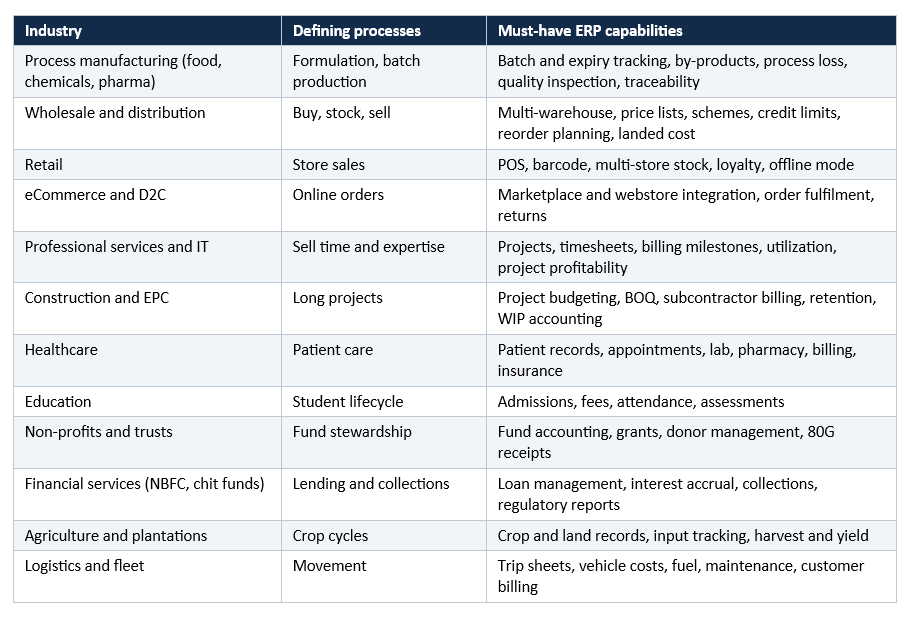
Which ERP fits each industry?
Manufacturing
Needs: BOM accuracy, production planning, shop floor reporting, subcontracting, actual costing, quality, traceability. ERPNext fit: Strong for SME and mid-market discrete and batch process manufacturing. Multi-level BOMs, work orders, job cards, production plans, material requests, subcontracting, batch and serial tracking, quality inspections, and from v16, Phantom BOMs. Consider alternatives when: you need finite capacity scheduling, MES integration at scale, or engineering change management as a core process. Shortlist SAP Business One, Dynamics 365 Business Central, or Odoo Enterprise alongside.
Wholesale and distribution
Needs: inventory accuracy across warehouses, pricing rules and schemes, credit control, fast invoicing with e-invoice and e-Way Bill, landed cost, reorder automation. ERPNext fit: Very strong. Pricing rules, promotional schemes, credit limits, pick lists, delivery trips, landed cost vouchers, reorder levels, and GST compliance are standard. Consider alternatives when: you are a pharma distributor dependent on scheme and expiry logic built into products like Marg, and have no appetite for configuration.
Retail
Needs: fast POS, barcode, offline capability, multi-store replenishment, loyalty. ERPNext fit: Moderate to good. POS with offline support, loyalty programmes, and store-level stock exist. High-footfall chains often integrate a specialist POS with ERPNext as the back office.
eCommerce and D2C
Needs: order sync from Shopify, WooCommerce, Amazon, and Flipkart, inventory sync, returns, payment gateway reconciliation. ERPNext fit: Good. The Ecommerce Integrations app covers Shopify, Amazon, and Unicommerce; WooCommerce connectors are available. Marketplace settlement reconciliation usually needs a custom report.
Professional services, IT, and consulting
Needs: project setup, timesheets, milestone and T&M billing, expense claims, utilisation, project P&L. ERPNext fit: Strong. Projects, tasks, timesheets linked to sales invoices, expense claims via Frappe HR, and project profitability reports are native.
Construction, real estate, and EPC
Needs: BOQ, project budgets, progress billing, retention, subcontractor RA bills, site stores, WIP. ERPNext fit: Moderate. Projects, budgets, multiple site warehouses, and subcontracting help. BOQ, RA billing, and retention need configuration or a custom app.
Healthcare
Needs: patient registration, appointments, clinical records, lab, pharmacy, IP billing, insurance. ERPNext fit: Available via the open-source Health app (Marley Health) on the Frappe Framework, integrated with ERPNext accounting and inventory. Suitable for clinics, diagnostic centres, and small to mid-sized hospitals. Large multi-speciality hospitals typically run a dedicated HIS with ERP for finance and supply chain.
Education
Needs: admissions, fee schedules and collection, attendance, courses, assessments. ERPNext fit: Available via the Frappe Education app. See our dedicated article on ERPNext for schools.
Non-profits, trusts, and associations
Needs: fund and grant tracking, donor records, membership, statutory receipts. ERPNext fit: Good. The Non Profit app covers members, donors, and grants; Accounting Dimensions handle fund accounting.
NBFCs, chit funds, and lending
Needs: loan origination, disbursement, repayment schedules, interest accrual, NPA classification. ERPNext fit: Frappe Lending covers loan management fundamentals. Regulated entities need additional regulatory reporting, often as a custom app.
Agriculture, plantations, and food
Needs: crop cycles, inputs, harvest, batch traceability, shelf life. ERPNext fit: Agriculture app for crop cycles; batch and expiry management in core for food processing.
Logistics and fleet
Needs: trip management, vehicle logs, fuel and maintenance cost, customer billing. ERPNext fit: Vehicle and vehicle log, delivery trips, and asset maintenance exist. Transport management beyond that is typically custom.
A six-step method to select an ERP for your industry
- Identify your three defining processes. These decide the shortlist.
- Write 20 to 30 scenario scripts from real transactions, including the awkward ones: sales return with partial credit, subcontracted job with scrap, advance with TDS.
- Shortlist three systems: one open source, one tier-two proprietary, and one vertical product if relevant.
- Run scripted demos. Make vendors demonstrate your scenarios with your data, not their slides.
- Score on weighted criteria: functional fit 30 percent, five-year TCO 25 percent, partner capability 20 percent, flexibility and integration 15 percent, vendor and ecosystem risk 10 percent.
- Reference check in your industry and confirm the named implementation team.
Common mistakes in industry ERP selection
- Selecting on brand reputation rather than scenario fit
- Letting the vendor’s standard demo drive the evaluation
- Ignoring finance and compliance while evaluating operational features
- Underestimating integration needs such as weighbridges, machines, and marketplaces
- Choosing a vertical product from a small vendor without assessing continuity risk
- Comparing licence price rather than five-year total cost
Frequently asked questions
Is there one best ERP for all industries? No. The best ERP is the one that handles your defining processes natively, fits your budget, and has a capable local partner.
Does ERPNext have industry-specific versions? ERPNext core covers manufacturing, distribution, retail, and services. Separate free apps on the Frappe Framework cover healthcare, education, non-profit, lending, agriculture, and hospitality.
Which ERP is best for small manufacturers in India? ERPNext is a strong default given zero licence cost, native manufacturing, and GST compliance. SAP Business One and Dynamics 365 Business Central are common proprietary alternatives.
Can one ERP handle a business with multiple lines, such as manufacturing and trading? Yes. ERPNext supports multiple companies and Accounting Dimensions to separate business lines within one system.
Should I choose the ERP my competitors use? It is a useful data point for functional fit, not a decision rule. Your scale, budget, and internal capability may differ.
How long should ERP selection take? Four to eight weeks for an SME using a structured process.
The bottom line
Industry fit is about a small number of critical processes. Test those rigorously, weigh five-year cost honestly, and choose a partner who understands both your industry and your finance function.
Finstein serves BFSI, healthcare, IT and ITeS, and manufacturing clients. We will demonstrate ERPNext against your own scenario scripts. Book a demo.